
STORAGE +
- Aug 21, 2017
- 7 min read
Storage Components
Hard Disk Drives

PLATTERS: Platter is a circular, metal disk that is mounted inside a hard disk drive. Several platters are mounted on a fixed spindle motor to create more data storage surfaces in a smaller area. The platter has a core made up of aluminium or glass substrate, covered with a thin layer of Ferric oxide or cobalt alloy. On both sides of the substrate material, a thin coating is deposited by a special manufacturing technique. This, thin coating where actual data is stored is the media layer.
SPINDLE: Spindle motor plays an important role in hard drive operation by turning the hard disk platters. A spindle motor must provide stable, reliable, and consistent turning power for many hours of continuous use. Many hard drive failures occur due to spindle motor not functioning properly.
READ/WRITE HEADS: The heads are an interface between the magnetic media where the data is stored and electronic components in the hard disk. The heads convert the information, which is in the form of bits to magnetic pulses when it is to be stored on the platter and reverses the process while reading.
HARD DISK LOGIC BOARD: Hard disk is made with an intelligent circuit board integrated into the hard disk unit. It is mounted on the bottom of the base casting exposed to the outer side. The read/write heads are linked to the logic board through a flexible ribbon cable.
DRIVE BAY: The entire hard disk is mounted in an enclosure designed to protect it from the outside air. It is necessary to keep the internal environment of the hard disk free of dust and other contaminants. These contaminants may get accumulated in the gap between the read/write heads and the platters, which usually leads to head crashes.
Data Interface : Where connect data cable to HDD (It may be ID/SATA/SCSI).
Types OF Hard Disk Drive (HDD)
Parallel Advanced Technology Attachment (PATA)
Serial ATA (SATA)
Small Computer System Interface (SCSI)
Solid State Drives (SSD)
Parallel Advanced Technology Attachment

These PATA drives were introduced by Western Digital back in 1986. They provided a common drive interface technology for connecting hard drives and other devices to computers. Data transfer rate can go up to 133MB/s and a maximum of 2 devices can be connected to a drive channel. Most of the motherboards have a provision of two channels, thus a total of 4 EIDE devices can be connected internally.
Serial ATA

These hard drives have replaced the PATA drives in desktop and laptop computers. The main physical difference between the two is the interface, although their method of connecting to a computer is the same. Here are some advantages of SATA disk drives.
SATA drives can transfer data faster than PATA types by using serial signaling technology.
SATA cables are thinner and more flexible than PATA cables.
They have a 7-pin data connection, with cable limit of 1 meter.
They consume less power. They only require 250 mV as opposed to 5V for PATA
Small Computer System Interface
These are quite similar to IDE hard drives but they make use of the Small Computer System Interface to connect to the computer. SCSI drives can be connected internally or externally. Devices that are connected in a SCSI have to be terminated at the end. Here are some of their advantages.
They are faster.

They are very reliable.
Good for 24/7 operations.
Have a better scalability and flexibility in arrays.
Solid State Drives
These are the latest in drive technology that we have in the computer industry. They are totally different from the other drives in that they do not consist of moving parts. They also do not store data using magnetism. Instead, they make use of flash memory technology. They make use of integrated circuits or semiconductor devices to s

tore data permanently, at least until they are erased. Here are some of their advantages.
Faster data access. Less susceptible to shock. Lower access times and latency. Durability. Less power usage.
Types Of removal Media
Optical discs (Blu-ray discs, DVDs,CDs)

an optical disc drive (ODD) is a disk drive that uses laser light or electromagnetic waves within or near the visible light spectrum as part of the process of reading or writing data to or from optical discs. Some drives can only read from certain discs, but recent drives can both read and record, also called burners or writers.
Compact discs, DVDs, and Blu-ray discs are common type
s of optical media which can be read and recorded by such drives
Memory cards (CompactFlash card, Secure Digital card, Memory Stick)

A memory card, flash card or memory cartridge is an electronic flash memory data storage device used for storing digital information. These are commonly used in portable electronic devices, such as digital cameras, mobile phones, laptop computers, tablets, PDAs, portable media players, video game consoles, synthesizers, electronic keyboards and digital pianos.
Zip disks/other Floppy disks
The Zip drive is a medium-to-high-capacity (at the time of its release) removable floppy disk storage system that was introduced by Iomega in late 1994. Originally, Zip disks launched with capacities of 100 MB, but later versions increased this to first 250 MB and then 750 MB.
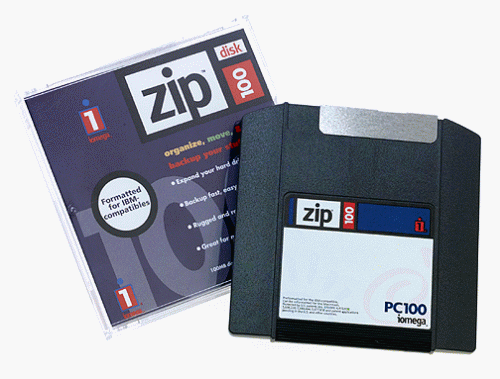
A floppy disk, also called a floppy, diskette, or just disk, is a type of disk storage composed of a disk of thin and flexible magnetic storage medium, sealed in a rectangular plastic enclosure line
d with fabric that removes dust particles. Floppy disks are read and written by a floppy disk drive (FDD).
Disk packs
Disk packs and disk cartridges were early forms of removable media for computer data storage, introduced in the 1960s.

A Disk pack is a layered grouping of hard disk platters (circular, rigid discs coated with a magnetic data storage surface). A disk pack is the core component of a hard disk drive. In modern hard disks, the disk pack is permanently sealed inside the drive. In many early hard disks, the
disk pack was a removable unit, and would be supplied with a protective canister featuring a lifting handle.
Magnetic tapes

Magnetic tape data storage is a system for storing digital information on magnetic tape using digital recording. Modern magnetic tape is most commonly packaged in cartridges and cassettes. The device that performs writing or reading of da
ta is a tape drive. Autoloaders and tape libraries automate cartridge handling.
Paper data storage (punched cards, punched tapes)

Punched tape or perforated paper tape is a form of data storage, consisting of a long strip of paper in which holes are punched to store data. Now effectively obsolete, it was widely used during much of the twentieth century for teleprinter communication, for input to computers of the 1950s and 1960s, and later as a storage medium for minicomputers and CNC machine tools.
Multiplexing
In telecommunications and computer networks, multiplexing (sometimes contracted to muxing) is a method by which multiple analog or digital signals are combined into one signal over a shared medium. The aim is to share a scarce resource. For example, in telecommunications, several telephone calls may be carried using one wire. Multiplexing originated in telegraphy in the 1870s, and is now widely applied in communications. In telephony, George Owen Squier is credited with the development of telephone carrier multiplexing in 1910.

Multi streaming
Multistreaming is a backup method by which a client sends multiple data streams simultaneously. Each data stream is a unique job and has a unique job ID as seen in the Activity Monitor.
Host bus adapter
In computer hardware, a host controller, host adapter, or host bus adapter (HBA) connects a computer, which acts as the host system, to other network and storage devices. The terms are primarily used to refer to devices for connecting SCSI, Fibre Channel and SATA devices. However, devices for connecting to IDE, Ethernet, FireWire, USB and other systems may also be called host adapters.
The term network interface controller (NIC) is more often used for devices connecting to computer networks, while the term converged network adapter can be applied when protocols such as iSCSI or Fibre Channel over Ethernet allow storage and network functionality over the same physical connection. These can include TCP offload engines.

Converged network adapter (CNA)
A converged network adapter (CNA), also called a converged network interface controller (C-NIC), is a computer input/output device that combines the functionality of a host bus adapter (HBA) with a network interface controller (NIC). In other words, it "converges" access to, respectively, a storage area network and a general-purpose computer network.
In networks without CNAs, servers have to have at least two adapters: One with a FC HBA to connect the server to the storage network, and another with a TCP/IP Ethernet NIC to connect the server to the LAN.
Using a single CNA to connect servers to storage and networks reduces costs by requiring fewer adapter cards, cables, switch ports, and PCIe slots. CNAs also reduce the complexity of administration because there is only one connection and cable to manage.

Port Channel
A port channel is an aggregation of multiple physical interfaces that creates a logical interface. You can bundle up to eight individual active links into a port channel to provide increased bandwidth and redundancy. Port channeling also load balances traffic across these physical interfaces. The port channel stays operational as long as at least one physical interface within the port channel is operational.
A port channel bundles physical links into a channel group to create a single logical link that provides the aggregate bandwidth of up to eight physical links. If a member port within a port channel fails, the traffic previously carried over the failed link switches to the remaining member ports within the port channel.

H-Vac
Heating, ventilation, and air conditioning (HVAC)is the technology of indoor and vehicular environmental comfort. Its goal is to provide thermal comfort and acceptable indoor air quality. HVAC system design is a subdiscipline of mechanical engineering, based on the principles of thermodynamics, fluid mechanics, and heat transfer. Refrigeration is sometimes added to the field's abbreviation as HVAC&R or HVACR, or ventilating is dropped, as in HACR (as in the designation of HACR-rated circuit breakers).HVAC is an important part of residential structures such as single family homes, apartment buildings, hotels and senior living facilities, medium to large industrial and office buildings such as skyscrapers and hospitals, onboard vessels, and in marine environments, where safe and healthy building conditions are regulated with respect to temperature and humidity, using fresh air from outdoors.


Comments